

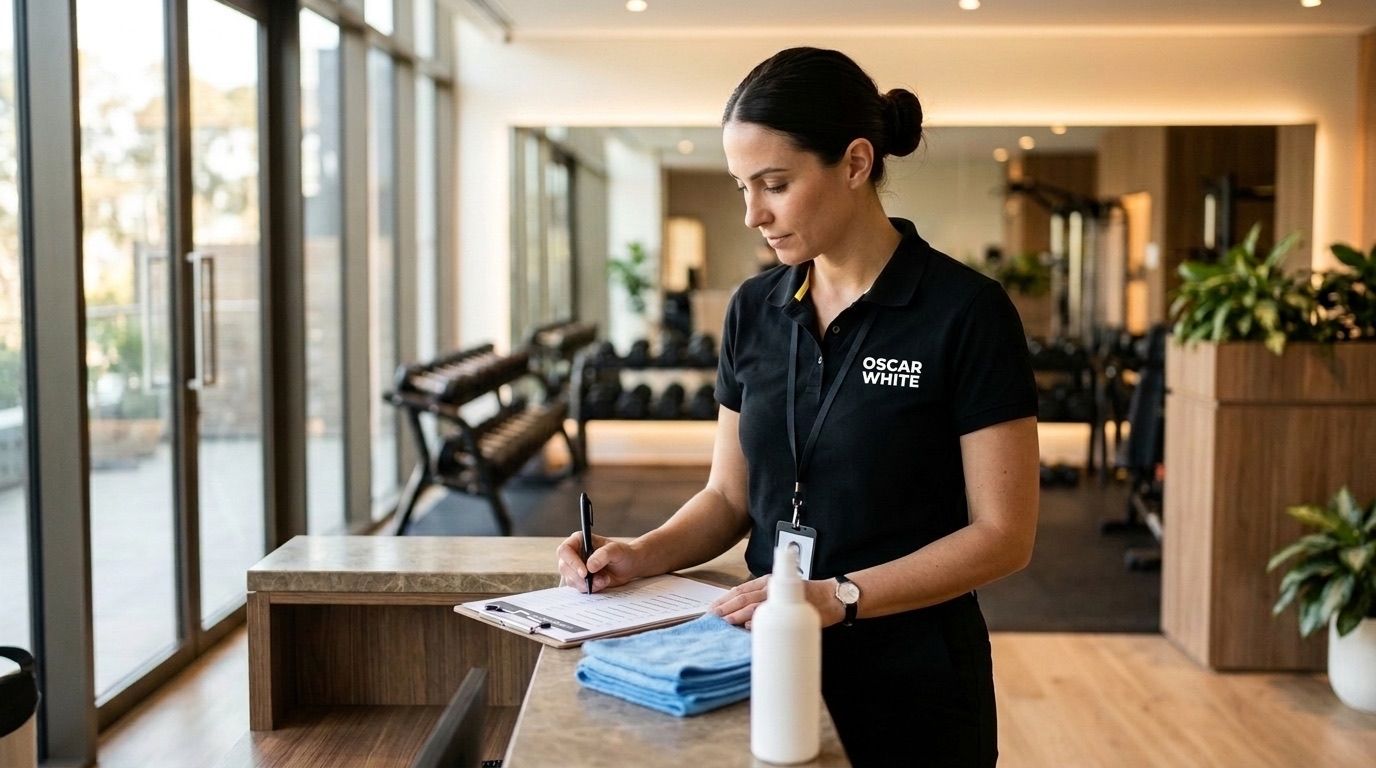
Members forgive an old treadmill. They do not forgive a change room that smells like one. Gym cleaning is a frequency problem before it is anything else, and the operators who keep members solve it with a written schedule rather than a general instruction to keep the place clean. Here is a working template, split the way it should be split: what happens every session, every day, every week and every month, and who actually does each layer.
The four-layer schedule
The staff layer and the professional layer are different jobs. Your floor team handles the constant light touches while the gym trades; the professional clean does the systematic work that needs equipment, products and time the floor team does not have. Gyms that blur the two end up with neither done properly.
| Frequency | What happens | Who |
|---|---|---|
| Every session / continuous | Wipe-down stations stocked; grips, benches and mats sanitised between heavy use; sweat spots addressed as they happen; bins cycled at peak | Floor staff + member wipe-down culture |
| Daily | All equipment touchpoints sanitised (grips, pads, screens, pins); floors vacuumed and mopped including under equipment edges; mirrors spot-cleaned; change rooms, showers and toilets fully cleaned and restocked; reception and high-touch surfaces done; bins out | Professional clean (early morning or late night) |
| Weekly | Full mirror walls; rubber flooring machine-scrubbed in traffic lanes; upholstery inspected and treated; wet-area descale started on rotation; vents and ledges dusted; odour treatment at source | Professional clean |
| Monthly / periodic | Full floor scrub corner to corner; deep descale of showers and wet areas; upholstery deep clean; high dusting (beams, ducts, light fittings); behind and under fixed equipment; carpet extraction in studios | Professional clean, scheduled window |
The zones that decide your reviews
Change rooms and showers are where members decide whether your gym is clean, and they need their own checklist, not a line inside a general one. Showers descale on a rotation or they grow the film every member notices; drains get treated before they smell, not after; consumables never run out on a Saturday morning. If you audit one thing after a clean, audit here.
High-touch equipment is a frequency question. Grips, adjustment pins, seat pads and touchscreens carry the load of every session and need sanitising on a cycle measured in hours while the gym trades, backed by the systematic daily pass. The wipe-down station culture helps; it does not replace the schedule.
Air and odour is the invisible zone. Odour is treated at the source: mats, bins, upholstery, drains and ventilation grilles on a defined rotation. Masking spray over a smelly source is how gyms end up smelling like perfume over a gym.
Products: effective, but equipment-safe
The sanitiser question matters more in a gym than almost anywhere else. Harsh chlorine-based products degrade upholstery, coated grips and rubber flooring faster than members do, and alcohol-heavy products craze acrylic screens. The working answer is a commercial-grade sanitiser that is effective on sweat-borne bacteria but safe on vinyl, coated steel and rubber, applied with microfibre rather than soaked. If your current cleaner cannot name what they use on your equipment and why, that is the conversation to have this week.
Making the schedule stick
A schedule nobody audits is a suggestion. Ours run as documented checklists with a report after every clean, so the owner sees what was done, when and by whom, and a slipping standard shows up in a photo within days rather than in a one-star review within months. Whoever cleans your gym, hold them to the same mechanism: written scope, defined frequencies, evidence after each visit.
If you run a gym or studio in Melbourne and want this schedule priced for your floor plan and timetable, a 15-minute call and a walkthrough gets you a fixed, itemised quote. Our gym and fitness cleaning page covers how we run these sites, and the cost calculator gives you a ballpark in a minute.
Frequently asked questions
How often should gym equipment be cleaned?
Touchpoints (grips, pins, pads, screens) need sanitising on a cycle measured in hours while the gym trades, on top of a systematic daily professional pass. Member wipe-downs help but do not replace either layer.
How often should gym change rooms and showers be cleaned?
Fully cleaned and restocked daily at minimum, with presentation checks through the day in busy facilities and descaling on a weekly-to-monthly rotation. Change rooms are the strongest single driver of member perception of cleanliness.
What cleaning products are safe on gym equipment?
Commercial-grade sanitisers that are effective against sweat-borne bacteria but safe on vinyl upholstery, coated grips, rubber flooring and acrylic screens, applied with microfibre. Harsh chlorine- or alcohol-heavy products degrade equipment faster than use does.
How much does gym cleaning cost in Melbourne?
Gyms are quoted as a fixed monthly price against a written scope and your timetable, after a walkthrough, not by the hour. Member hours, intra-day touchpoint cycles and equipment mix move the number too much for a published band to mean anything. As market context, recurring member-facing scopes across Melbourne typically land at $5.00 to $14.00 per square metre per month ex GST; our own price is a fixed monthly figure against your written scope, and it carries intra-day touchpoint cycles, equipment-safe chemistry and photo sign-off after every visit.