

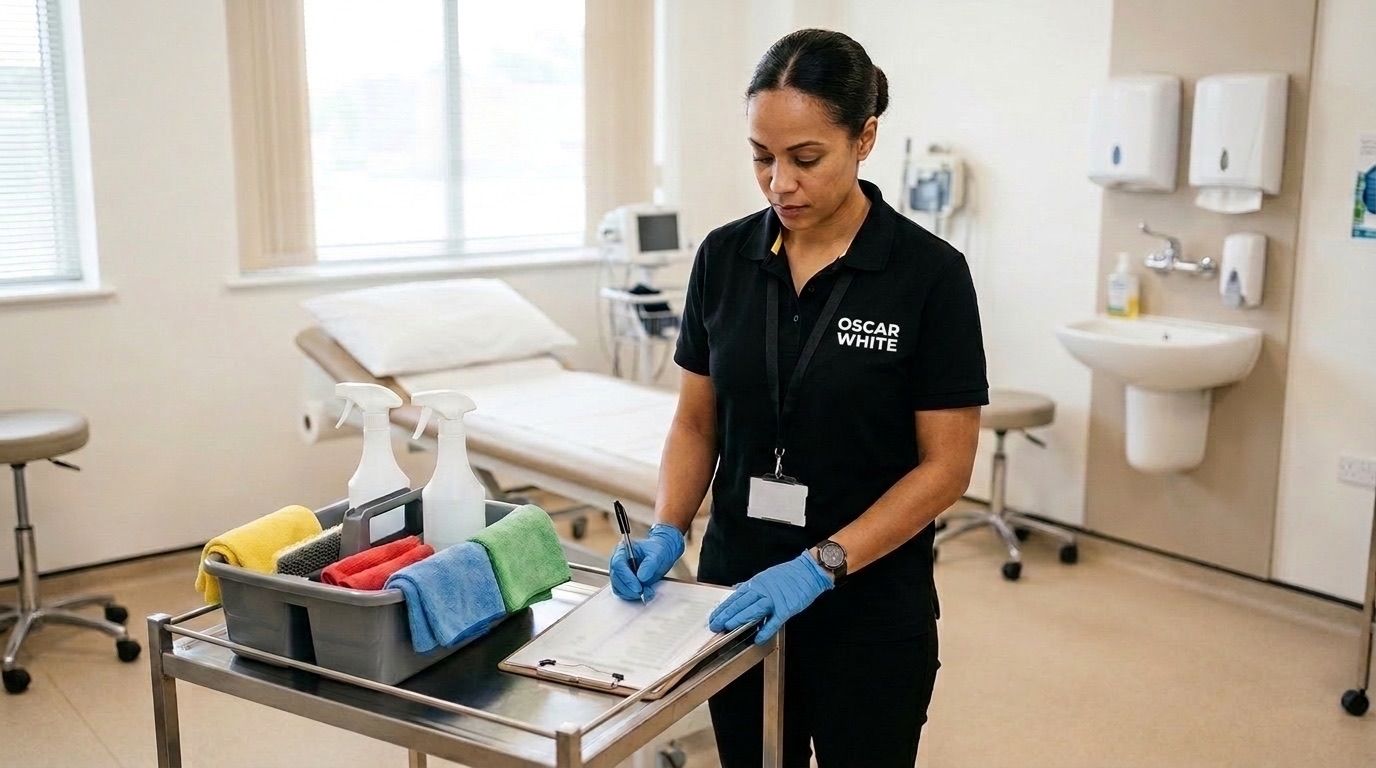
In a general office, cleaning is presentation. In a medical practice, it is infection control, and the difference is not the effort involved. It is the system: what is used, in what order, how often, and whether any of it can be evidenced when accreditation asks.
The reference point is the Australian Guidelines for the Prevention and Control of Infection in Healthcare, which set the principles office-based practice borrows: clean before you disinfect, separate clinical from non-clinical areas, match the product to the risk, and document the process. Accreditation frameworks for general practice expect documented cleaning processes consistent with that guidance. A verbal assurance from a cleaner does not survive an assessor’s questions.
Products are the first place generic cleaning fails a clinic. Clinical-area disinfection calls for TGA-listed hospital-grade disinfectants, applied at the labelled dilution and left for the labelled contact time. A disinfectant wiped dry on contact has disinfected nothing; a domestic product in a treatment room is the wrong tool regardless of how it smells.
Colour-coding is the second. Cloths, mops and buckets are separated by zone (typically washrooms, clinical areas and general areas) so contamination cannot commute from the toilet to the treatment bed via a cleaning cloth. It is a simple discipline that is either enforced by supervision or quietly abandoned within weeks.
Frequency should follow risk, not routine. High-touch points (door handles, reception counters, EFTPOS terminals, waiting-room armrests, light switches) carry a defined frequency of their own, separate from floors and general surfaces. Treatment and consult rooms are turned over to schedule; waiting areas may need presentation attention through the day in a busy practice.
Sequence and separation matter inside each room too: clean surfaces before floors, low-risk areas before high-risk in general spaces, and reverse the emphasis where a spill or a clinical incident makes an area dirty. These are trained behaviours, which is why the consistency of the crew matters as much as the checklist: a rotating cast of casuals cannot hold a protocol.
Waste is part of the cleaning system, not an afterthought. General, recycling and clinical waste streams stay separated through collection, and the handling of sharps containers and clinical bins follows the practice’s own protocol, documented in the site file.
Then there is the part assessors actually read: documentation. A written cleaning protocol for the site, logs of what was cleaned and when, the products in use and their dilutions, and a report after every clean. When an accreditation review or a complaint asks how the rooms are cleaned, the answer should be a paper trail. Ours arrives as a report after every visit.
Questions worth putting to any bidder for a clinic contract: which TGA-listed disinfectants will you use, and at what contact times? How is your equipment colour-coded? What is your high-touch frequency? Who supervises, and what documentation do we receive? A capable operator answers in specifics. A generic one changes the subject to price.
If your practice is due for accreditation or the current arrangement would not survive the questions above, a 15-minute call and a walkthrough is enough to put a documented, clinic-grade cleaning protocol in front of you, built on the same documented model as our commercial cleaning, tightened to clinical requirements.
Frequently asked questions
What disinfectants should be used in a medical practice?
TGA-listed hospital-grade disinfectants in clinical areas, applied at the labelled dilution and left for the labelled contact time. Domestic products are not appropriate for treatment or consult rooms.
What cleaning documentation does practice accreditation expect?
A written cleaning protocol for the site, evidence of what is cleaned and how often, the products in use, and records of completed cleans. A cleaner who reports after every visit gives you that audit trail by default.
How often should high-touch surfaces be cleaned in a clinic?
On a defined frequency set by the practice’s risk profile. Busy waiting rooms may need attention several times a day, while consult rooms are turned over to schedule. The point is that the frequency is documented and held, not left to judgement on the night.