

The brief
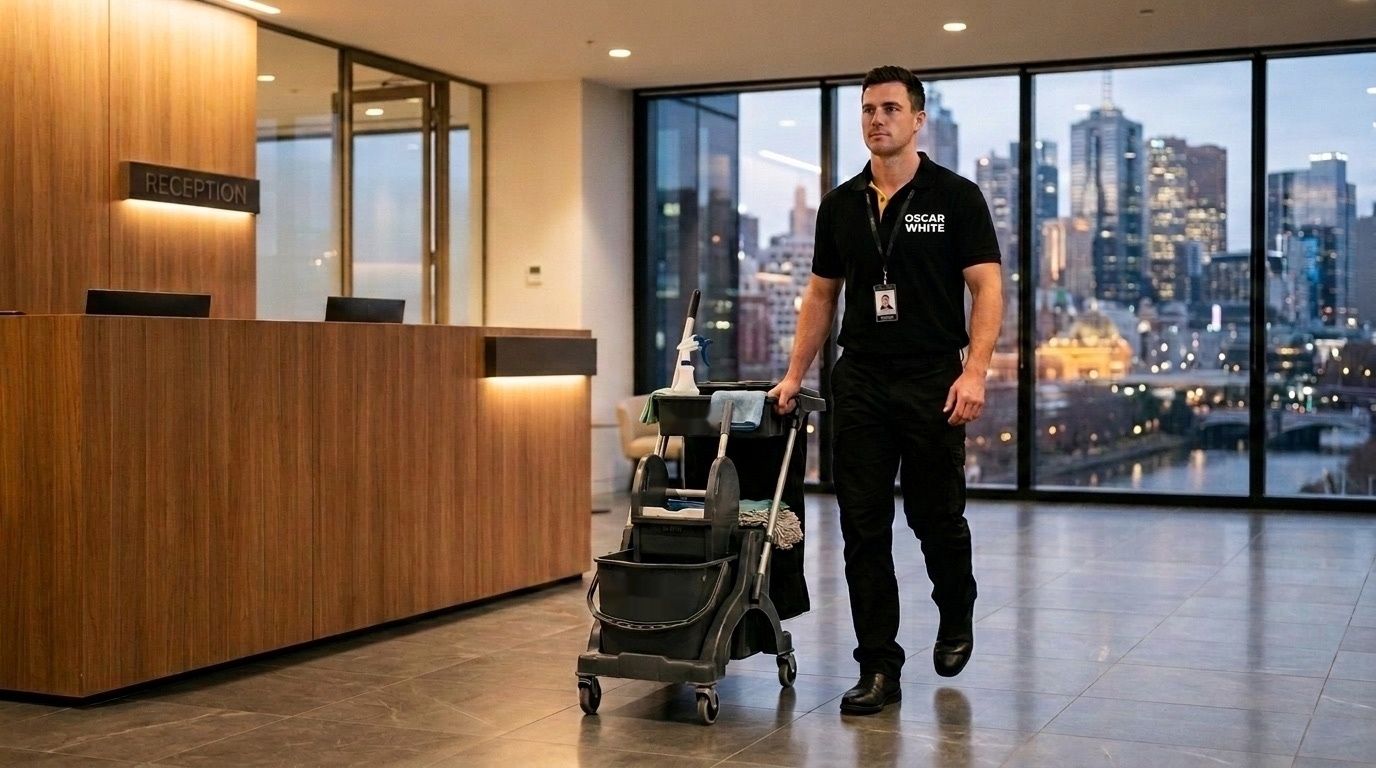
Accounting, legal, financial services, consulting and architecture practices share one problem: the office is part of the advice. A client who sits in your boardroom is reading the room while you talk. We keep reception, boardrooms and client-facing floors consistently polished, so the space works as hard on your reputation as your people do.
What we solve for
- Client-facing reception & boardrooms held to a higher standard
- After-hours scheduling around client meetings and late-working staff
- Confidentiality: open files, deal rooms and unlocked screens
- Consistent presentation across multiple floors and suites
The standard is the walkthrough test
Professional-services floors are judged the way a client judges them: walking in the front door. So the scope is built around the walkthrough path (reception, lift lobbies, boardrooms, client suites and the glass everyone touches on the way through) and held there by documented checklists, a photo report after every clean, and rectification at our cost if the standard slips.
Presentation drift is the failure mode of these contracts. It is never announced. It arrives as one missed week, then a fortnight of “near enough”, and it is usually discovered by a partner standing in reception with a client. Our reporting exists so a slipping standard is corrected from a photo inside a week instead.
Confidentiality is a cleaning problem
A practice hands its cleaner more sensitive material than most of its staff see: files left open on desks, deal rooms mid-negotiation, client names on whiteboards, printouts in the bin. Most cleaning contracts never mention it. Ours does, because it is the reason the same person returns to your site every visit rather than whoever the roster sent.
Your cleaner is uniformed and ID-tagged, works to a site file that documents security inductions, swipe-card management, alarm procedures and after-hours protocols, and is inducted before the first clean. The building manager never has to chase paperwork, and reception is never meeting a stranger after hours.
When practices actually change cleaner
Almost nobody changes cleaning contractor because they went looking. It happens for four reasons: the incumbent slipped and the fix did not hold, the practice moved or fitted out, an audit or accreditation put the site under a light, or the contract came up for review, which is what the 4.75% award rise on 1 July has just triggered across Melbourne.
If any of those is live for you, a 15-minute call and a walkthrough is enough to put an itemised quote against a written scope in your hands. If none of them are, keep our number until one is.
Three fixed monthly packages, priced against a written scope.
- Light Office 2 nights a week $1,400–$1,700/mo ex GST
- Standard Office 3 nights a week $2,000–$2,400/mo ex GST
- Daily Office 5 nights a week $3,300–$3,900/mo ex GST
Bands assume a typical professional-services floor of roughly 250–450 m². See the full package ladder →
Common questions
Can you clean around client meetings and late-working staff?
Yes. Most professional-services cleans run after hours or early morning, and the schedule flexes around board meetings, client functions and end-of-quarter crunch. Your cleaner is discreet, uniformed and ID-tagged.
How do you handle confidential files and deal rooms?
They are scoped explicitly at the walkthrough. Rooms can be excluded, cleaned only when unlocked, or cleaned on a documented protocol: your choice, written into the site file rather than left to judgement. The same cleaner returns each visit, which is the single biggest control you have.
Can you keep one standard across multiple floors or suites?
Yes. One documented scope and one reporting line cover all floors and suites, so the standard on level 12 matches the standard in reception.
What does cleaning a professional-services office cost?
It is sold as a monthly package against a written scope, not an hourly rate. Light Office (two nights a week) starts at $1,400 a month ex GST, Standard Office (three nights) at $2,000, and Daily Office (five nights) at $3,300. The bands assume a typical floor of roughly 250 to 450 square metres; larger or unusual sites are quoted after a walkthrough.